
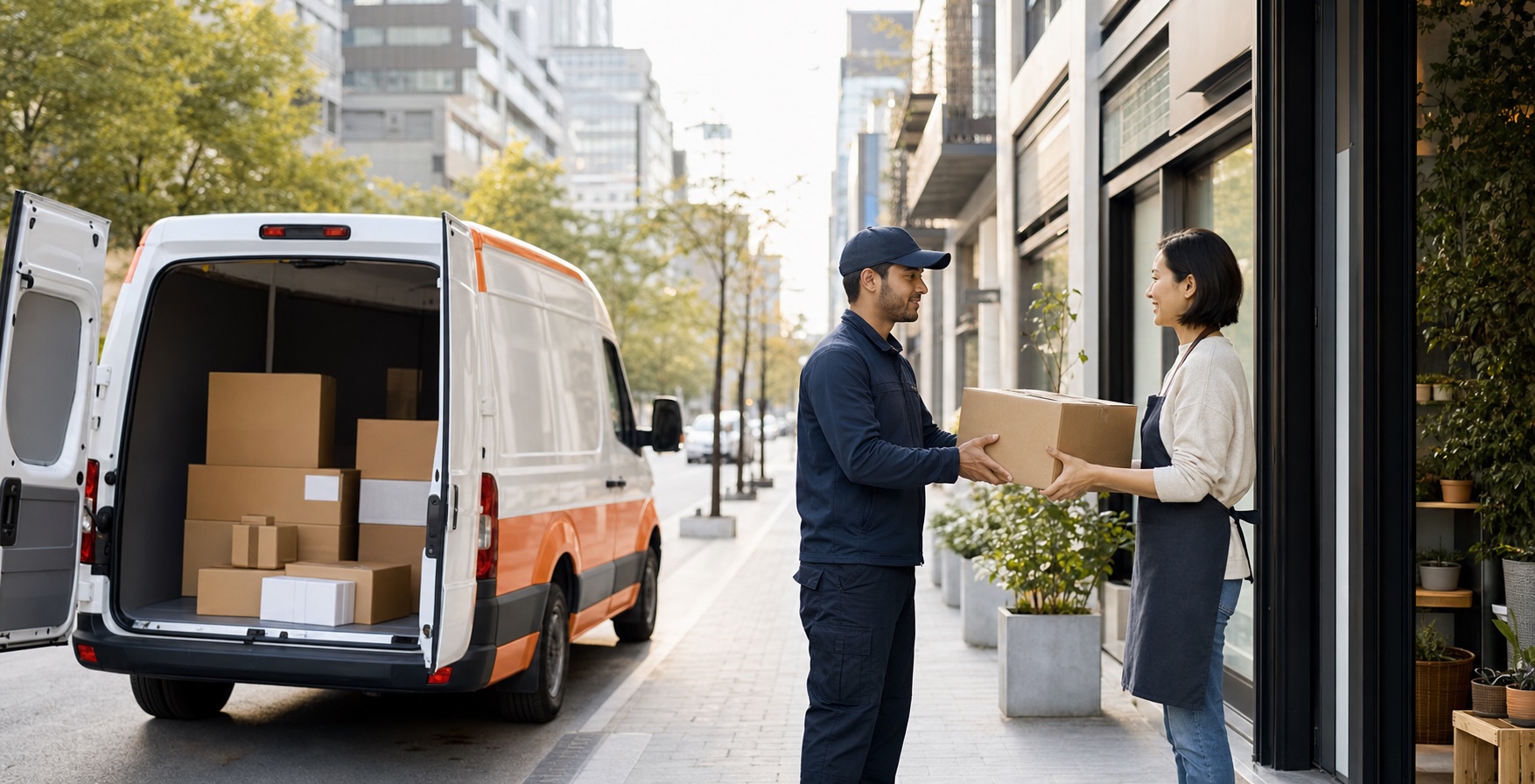
Consolidation lowers repeated handling and transport cost by grouping goods or parcels, while last-mile delivery determines what the customer actually experiences. The two should be planned together using packaging, cut-off, tracking and delivery-promise rules.
What consolidation changes
Supplier consolidation brings goods from several origins into one warehouse before international dispatch. Parcel consolidation groups ecommerce orders for the shared international leg before they enter destination delivery networks. Both approaches can reduce repeated movements, but they add a cut-off and sorting step that must be reflected in the promised timeline.
Five choices that shape the result
Waiting longer may reduce cost, but it can erase the customer-time benefit.
Each item or parcel must retain the correct SKU, order and destination identity through regrouping.
Balance parcel protection, dimensional weight, opening experience and destination rules.
Explain when the international tracking becomes visible and when a local carrier takes over.
Define who handles address errors, failed delivery, damage, loss and return requests.
Connect logistics metrics to customer outcomes
| Operating metric | Customer effect |
|---|---|
| Warehouse cut-off adherence | Whether the order enters the planned dispatch cycle. |
| Correct first scan | Whether tracking begins with the right parcel identity. |
| Damage rate | Whether packaging protects the product across multiple handoffs. |
| First delivery success | Whether address quality and delivery instructions work. |
| Exception response time | How long the customer waits for a useful answer. |
Use different rules for different orders
A single route rarely fits every order. High-value or urgent parcels may need stronger tracking and faster service. Remote destinations may need a different carrier. Low-value replenishment may tolerate a longer consolidation window. Define route rules by destination, product, weight, value and promise instead of choosing manually every time.
Questions to ask before launch
- When does the consolidation window close?
- Which scan becomes visible to the customer?
- Does the local carrier cover the full destination area?
- What packaging failures have occurred before?
- Who contacts the customer after a failed delivery?
- How are returns routed and recorded?